Monday, October 26, 2009

In One Man's Garage, Pan Am Still Makes the Going Great

Fliers nostalgic for the golden era of air travel might want to book a trip to Anthony Toth's garage.

Mr. Toth has built a precise replica of a first-class cabin from a Pan Am World Airways 747 in the garage of his two-bedroom condo in Redondo Beach, Calif. The setup includes almost everything fliers in the late 1970s and 1980s would have found onboard: pairs of red-and-blue reclining seats, original overhead luggage bins and a curved, red-carpeted staircase.

Brian L. Frank for The Wall Street Journal

A coffee maker with a Pan Am logo sits in the replica cabin Anthony Toth built in his Redondo Beach, Calif., home

Once comfortably ensconced, Mr. Toth's visitors can sip beverages from the long-defunct airline's glasses, served with Pan Am logo swizzle sticks and napkins, plus salted almonds sealed in Pan Am wrappers. They can even peel open a set of plastic-wrapped, vintage Pan Am headphones and listen to original in-flight audio recordings from the era, piped in through the armrests.

Mr. Toth, a 42-year-old global sales director at United Airlines, has spent more than 20 years on his elaborate recreation of a Pan Am cabin, which includes a few economy-class seats, too. All told, Mr. Toth estimates he has spent as much as $50,000 on the project, which he hopes someday to turn into a museum.

"The brand was so powerful, he says. "They had this uncompromising standard of service."

[PanAm Bag]

To find artifacts from the airline, which ceased operation in 1991, Mr. Toth spends his vacations trekking out to an area in the Mojave Desert known as the airplane boneyard, where retired aircraft are stripped for parts. When he can't buy an original Pan Am item in good condition, like seat covers, he recruits professionals to create suitable stand-ins.

Julie Fisher, a friend of Mr. Toth's, says one time she got a call from Mr. Toth saying he'd heard about a source for headsets in Bangkok. A few days later, the two of them hopped a plane to Thailand for the weekend to track them down. (As an airline employee, Mr. Toth can usually fly himself and a friend for free if space is available.)

In the 1930s, Pan Am became the first U.S. airline to fly internationally, and in the 1970s, the first to fly Boeing 747 jumbo jets. Pan Am was once synonymous with international jet-setting, with upper-deck dining rooms and flight attendants decked out in crisp blue uniforms, high heels and white gloves. First-class travelers were served out of silver-plated martini pitchers. A parade of linen-covered food carts made its way down the aisle at dinnertime.

The airline began struggling financially in the 1970s as fuel prices soared and competition on international routes escalated. Still, Pan Am made few cutbacks to its first-class service.

In 1988, a Pan Am flight was bombed by terrorists above Lockerbie, Scotland, killing 270 people. The airline declared bankruptcy in 1991. A commuter airline called Pan Am Clipper Connection operated out of New Hampshire using the company's blue globe logo until last year. United Airlines, Mr. Toth's current employer, purchased the Pacific division of Pan Am in 1985.

Hopping On Board Pan Am

2:41

Anthony Toth has been working on his replica of a first-class Pan Am cabin for 20 years. Candace Jackson tours Toth's homage to the golden era of air travel.

M. Kelly Cusack, a fellow Pan Am enthusiast and memorabilia collector who worked for the airline from 1980 to 1991, runs a Web site that chronicles the airline's history. He met Mr. Toth several years ago while working at United and says he doesn't know of many other collectors who've gone as far in reconstructing an actual airplane cabin in their home.

Mr. Toth's obsession with Pan Am began in the 1970s when he was growing up in Cuyahoga Falls, Ohio, about 45 minutes from Cleveland Hopkins International Airport. Every summer, he and his family traveled to see relatives in Rome and Budapest, where his parents were from, usually flying in Pan Am's coach class. "There was no other aircraft I could walk on board that intrigued me more than the Pan Am cabin," he says. "Everything symbolized something. That meant something to me as a youngster."

As a child, Mr. Toth would save items that most passengers considered to be trash, such as cardboard coasters and paper tray linings from coach meal services. On every flight, he would carry a camera and shoot three or four rolls of film documenting the aircraft's interior. He lugged a boxy tape recorder to capture in-flight audio by cranking the dial on his armrest up to level 12 and placing the microphone to the earphones so he could listen to the airline's music selection back home.

For his 10th birthday, Mr. Toth says he persuaded his parents to sign him up for an annual subscription to the Official Airline Guide, which lists flight timetables and is typically used by travel agents. When he was 12, he created a 20-foot mock-up of the interior of a Pan Am first-class cabin in his family's basement, making seats out of wood. "This consumed my world," he says.

Since his 20s, Mr. Toth has worked for United in a variety of positions and places, including Chicago, Raleigh, N.C., and San Francisco. He created early versions of his airline cabin in the living rooms of various apartments and houses he rented when he was in his 20s and 30s.

Brian L. Frank for The Wall Street Journal

Anthony Toth built a replica Pan Am first-class cabin in his garage.

Two years ago, Mr. Toth, who is single, purchased his first home. He says he looked at nearly 50 apartments before finding one with a slightly oversize garage that would have enough space for his cabin configuration.

There's one modern update: Mr. Toth installed a flat-panel TV instead of the old projection version that would have been used in the 1980s so he could watch movies and TV using his Pan Am headphones. Airline buffs will notice that the walls actually are from a DC-10 aircraft, not a 747, though he hopes to change that soon.

While the cabin isn't open to the public, friends and fellow airline enthusiasts frequently hang out there, he says. Beverage service is included in a visit, as is a custom souvenir boarding pass and first-class luggage tags that look identical to Pan Am's from the early 1980s. Occasionally, he'll prepare a meal in the galley, though usually he orders takeout and serves it on his vintage Pan Am china and serving trays. Mr. Toth has even hosted his United colleagues for corporate meetings.

"His passion for the industry goes well beyond what [he has] at home," says Mr. Toth's boss, Jeff Foland, senior vice president of world-wide sales and distribution for United.

Today's first-class cabins, with reclining, lie-flat seats, on-demand gourmet meals and individual televisions have advanced far beyond the lower-tech cabins of the 1970s and 1980s. But today's airline service and branding just aren't the same, says Mr. Toth.

In the good old days, "I didn't want to sleep when I flew," he says. "I wanted to spend every minute enjoying everything that was happening."


Sunday, September 27, 2009

British Airways sets seat charges

Opinion: BA can afford to do this when they have control of a route. I doubt they will be able to retain customer loyalty on the more competitive routes as this move is not ideal for travel groups

BBC: Friday, 25 September 2009
A BA plane
British Airways said seat charges will give customers "more control"

British Airways passengers will have to pay to choose their seats before they travel from October, the airline says.

The charges will affect those seeking to ensure they sit together on a flight and people with a preference for window, aisle or emergency exit seats.

Prices range from £10 per person for European economy flights, to £60 for long haul trips in business class.

Consumer group Which? said it was "disappointing to see British Airways jumping on the bandwagon".

BA said it would "give customers more control over their seating options". The new charges will come into force on 7 October.

'Extra charges'

The airline currently allows passengers to reserve seats in the 24 hours prior to departure.

We know from our members that people really don't like these extra charges - they'd much rather see a headline price that includes everything
Which? Holiday

The new charge - aimed at passengers wanting to reserve seats earlier than this - will be £20 on long-haul economy or short flights in business class, while a seat in an emergency exit row will cost £50.

This can be booked between 10 and four days before take-off.

A BA spokeswoman said: "Customers frequently request specific seats, but in the past we've only been able to confirm them 24 hours in advance or on the day.

"We know people want to secure them in advance and have real control over their flying experience. This will allow them to do that."

Rochelle Turner, head of research at Which? Holiday, said travellers had become used to budget airlines charging them for a service that used to be included in the "headline price".

"We know from our members that people really don't like these extra charges - they'd much rather see a headline price that includes everything," she said.

"BA is still giving some people the chance to reserve their seat for free in the 24 hours before departure, but if you aren't quick enough off the mark, you could find yourself sitting on the other side of the plane from your family or partner.

"It's no way to start a holiday."

The move comes as the airline attempts to bolster its balance sheet after a £401m loss in the last financial year.

And it follows BA's decision to cut luggage allowances and abolish free meals on short flights.

Monday, September 14, 2009

Iconic Greyhound bus on track for UK launch

View: I've been on the Greyhound 3 or 4 times (before Greyhound was sold to a UK company in 2007), all I can say is that you can meet all sorts of people, some are not pleasant. So this is indeed a fresh perspective for the British traveler, how long will it be before this luxury service hits the US? I think it will be very limited due to the geography that favors air travel


LONDON, England (CNN) -- For almost a century, the old dog has traversed landscapes across the United States, with weary, budget-conscious travelers peeking out of its windows.

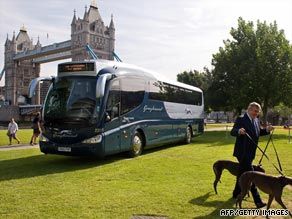
Greyhound bus services will run from London to cities such as Portsmouth and Southampton.

Greyhound bus services will run from London to cities such as Portsmouth and Southampton.

Now, the iconic Greyhound is taking to the road in Britain. The company will run hourly bus services from London to select cities, starting Monday.

In contrast to its U.S. services, however, the buses are glitzier and more luxurious.

"The UK service will have wireless Internet, spacious leather seats, more leg room and free newspapers," said Alex Warner, managing director of Greyhound UK. "Obviously, we wanted our services to reflect the nature of UK passengers."

For inaugural Greyhound service in Britain, the company aimed to start with the best the United States has to offer, Warner added.

In North America, the same services are available from New York and Washington to select cities such as Boston and Toronto, Canada.

"There are plans to expand that. Americans should watch closely. We will introduce more of these services based on how well they are received in the UK," Warner said.

Despite the added benefits, fares will still target the budget-conscious traveler in Britain, according to Warner.

The service starts with a few cities -- from London to Portsmouth and Southampton, he said. The approximately 120-kilometer (80-mile) trip will cost £1 ($1.60) if a ticket is bought in advance, Warner said. Prices will go up to £4 or £5, depending on time of purchase.

"We are planning to keep the prices within that range," Warner said.

Greyhound Lines is owned by British transport company FirstGroup, which bought it from its U.S. parent in 2007. It was founded in 1914, and has services in Mexico and Canada, according to its Web site.

In a nod to its cameos in American movies and songs, such as the 1969 film "Midnight Cowboy" and Simon and Garfunkel's 1972 hit "America," Greyhound plans to keep at least one tie to its U.S. origins. Buses in Britain will be named after classic American songs.

The names include "Sweet Caroline" and "Good Golly Miss Molly," Warner said.

Now, everyone in US will know Malaysia better

View: Wow! Air Asia X is pushing new frontiers! That is an interesting route, I checked AirAsia.com but it still doesn't have pricing yet

By LIM AI LEE - The Star


OAKLAND (California): AirAsia X has arrived in the United States with “Xcellence” - its Airbus A340 - touching down here on Monday morning.

The no-frills airline is the first from Asia to associate itself with a performance driven National Football League team, the Oakland Raiders.

Newly-appointed Malaysian Ambassador Datuk Seri Dr Jamaludin Jarjis, who was at the Oakland International Airport to witness the touchdown, congratulated AirAsia for promoting a Malaysian brand in the US.

“This is a great step in building bilateral ties and contribute to the development of the tourism industry in this part of the world and in Malaysia,” Dr Jamaludin said at his first official function since presenting his credentials to Deputy State Secretary Dr James B. Steinberg in Washington on Friday.

Also present were the city’s Mayor Ron Dellums, Oakland Raiders owner Mark Davis and CEO Amy Trask, AirAsia X CEO Azran Osman-Rani and director Datuk Lim Kian Onn.

“With AirAsia, we will see new business opportunities in the services sector,”he said.

Dr Jamaludin said he hoped relations between Malaysia and the US would be further enhanced under his tenure.

There are 5,428 Malaysians studying in over 250 universities in the US and AirAsia would provide them with an affordable means of transport.

Tuesday, September 1, 2009

Airline industry lost over $6 billion in 1st half

Airlines group says global industry lost over $6 billion in first half, some signs of recovery
On Tuesday September 1, 2009, 9:22 am EDT

GENEVA (AP) -- Airline companies lost more than $6 billion during the first half of the year due to the economic crisis, even as fresh figures showed some signs of recovery in the passenger and freight business, an industry group said Tuesday.

A sample of more than 50 airlines found their losses declined to $2 billion in the second quarter from $4 billion in the first quarter, the International Air Transport Association said, noting that the April-June period is usually a strong one for the industry.

"Since the sample of airlines is incomplete, total industry losses in the first half of 2009 are likely to have been in excess of the reported $6 billion," IATA said.

The Geneva-based group, which represents 230 airlines worldwide, said seat occupancy in international markets stabilized in July -- the first time in over a year -- but added that airlines need to further cut capacity to meet demand.

Freight capacity also still exceeds demand despite an 8.1 percent capacity cut in July, IATA said.
"With excess capacity continuing through Q2 it was not surprising that freight rates were down more than 20 percent over the year," it said.

Overall, the industry outlook remains volatile, IATA said.
Airlines are still adding to their fleet because of long-term orders committed to before the downturn.

Figures show companies increased their aircraft numbers by a net of 487, or about 2 percent of their overall fleet."Replacement and expansion of the fleet has delivered significant fuel efficiency savings," IATA said.
The group noted that rising fuel prices are once again eating into airlines' cash reserves.
Airline shares have risen 7.4 percent since the start of the year, lagging behind overall market improvements of 23 percent.
"Nonetheless, stronger equity markets gave airlines an opportunity to raise more -- much needed -- cash," IATA said.
Airlines have raised $3 billion of equity and $12 billion from new debt issues since the start of the year, it said.

Saturday, August 29, 2009

Driven to driving a taxi despite having a PhD

Saturday August 29, 2009 - THESTAR.COM.MY

INSIGHT DOWN SOUTH
By SEAH CHIANG NEE

Bio-chemist Dr Cai Minnjie who failed to land another research position after losing his job last year now happily prowls the streets as a cabbie.

SINGAPORE’S fraternity of taxi drivers, with its fair share of retrenched executives, has now an exalted new member – a PhD bio-chemist from Stanford University.

Prowling the streets of Singapore today is 57-year-old unemployed scientist Dr Cai Mingjie who lost his job at Singapore’s premier A-Star biomedical research institute last year.

The China-born naturalised citizen with 16 years of research accomplishments said he began driving a taxi last October after failed efforts to land another job.

The news shocked this nation, which holds an unshakable faith in the power of an advanced university education.

One surprised white-collar worker said he had believed that such a doctorate and experience was as good as life-long employment and success.

“If he has to drive a taxi, what chances do ordinary people like us have?” he asked.

I have met a number of highly qualified taxi drivers in recent years, including former managers and a retrenched engineer.

One cheerful driver – a former stock-broker – surprised me one day in giving me detailed reasons on what stocks to buy or avoid.

“At a time like this, the taxi business is probably the only business in Singapore that still actively recruits people,” said Dr Cai.

To me, his plight is taking Singapore into a new chapter.

“(I am) probably the only taxi driver in the world with a PhD from Stanford and a proven track record of scientific accomplishments ...,” blogged Dr Cai.

“I have been forced out of my research job at the height of my scientific career” and was unable to find another job “for reasons I can only describe as something uniquely Singapore”.

The story quickly spread far and wide over the Internet. Most Singaporeans expressed admiration for his ability to adapt so quickly to his new life. Two young Singaporeans asked for his taxi number, saying they would love to travel in his cab and talk to him.

“There’s so much he can pass on to me,” one said.

Others questioned why, despite his tremendous scientific experience, he is unable to find a teaching job.

His unhappy exit is generally attributed to a personal cause (he has alleged chaotic management by research heads) rather than any decline in Singapore’s bio-tech project, which appears to be surviving the downturn.

The case highlights a general weakening of the R and D (research and development) market in smallish Singapore.

“The bad economy means not many firms are hiring professional scientists,” one surfer said. “Academia isn’t much of a help – there’s a long history of too many PhDs chasing too few jobs.”

While the image of taxi drivers has received a tremendous boost, the same cannot be said of Singapore’s biomedical project – particularly its efforts to nourish home-grown research talent.

“It may turn more Singaporeans away from Life Sciences as a career,” said one blogger.

One writer said: “In my opinion, PhDs are useless, especially in Singapore. It’s just another certificate and doesn’t mean much.”

Another added: “The US is in a worse situation. Many are coming here to look for jobs.”

“I won’t want my child to study for years to end up driving a taxi,” said a housewife with a teenage daughter.

The naturalised Singaporean citizen underwent his PhD training at Stanford University, the majority of his work revolving around the study of yeast proteins.

His case is not unique. US research-scientist Douglas Prasher, who isolated the gene that creates the green fluorescent protein (and just missed the 2008 Chemistry Nobel Prize) faced similar straits.

Prasher moved from one research institution to another when his funding dried up, and he eventually quit science – to drive a courtesy shuttle in Alabama.

“Still, he remains humble and happy and seems content with his minivan driver job,” said a surfer.

With an evolving job market as more employers resort to multi-tasking and short-term contracts, more Singaporeans are chasing after split degrees, like accountancy and law or computer and business.

Others avoid post-graduate studies or specialised courses of a fixed discipline in favour of general or multi-discipline studies. “Experience is king” is the watchword; there has been a rush for no-pay internships.

“The future favours graduates with multiple skills and career flexibility, people who are able to adapt to different types of work,” one business executive said.

During the past few years, as globalisation deepened, there has been a growing disconnect between what Singaporeans studied in university and their subsequent careers.

It follows the trend in the developed world where old businesses disappear – almost overnight – and new ones spring up, which poses problems for graduates with an inflexible job expectation.

I know of a young man who graduated from one of America’s top civil engineering universities abandoning the construction hard hat for a teaching gown.

Another engineer I met is running his father’s lucrative coffee shop. Lawyers have become musicians or journalists, and so on.

Cases of people working in jobs unrelated to their university training have become so common that interviewers have stopped asking candidates questions like “Why should a trained scientist like you want to work as a junior executive with us?”

In the past, parents would crack their heads pondering what their children should study – accountancy or law or engineering, the so-called secure careers – and see them move single-mindedly into these professions.

A doctor was then a doctor, a biologist generally worked in the lab and a lawyer argued cases in courts – square pegs in square holes, so to speak.

Today the world is slowly moving away from this neat pattern.

Monday, August 17, 2009

Ryanair closing Manchester routes

View: Ryanair being a large airline seems to be using its muscle to squeeze for lower operating costs. Airports tend to loose out if major airlines pack and leave, but an airport's ability to draw the passengers will determine who wins this battle on costs

BBC Monday, 17 August 2009 17:15 UK

Ryanair is to switch or close nine of the 10 routes it currently operates from Manchester Airport, blaming the airport's refusal to lower its charges.

The firm said most affected flights would be switched to East Midlands, Leeds Bradford, and Liverpool airports.

Ryanair said the change would result in the loss of up to 600 local jobs, a claim disputed by the airport.

The airport told BBC News job losses would be limited, but said the budget airline's decision was "regrettable".

"We also have all but one service that Ryanair offers, served by other airlines that operate at Manchester," said chief executive of Manchester Airport Group, Geoff Muirhead.

"So the damage will be limited."

Full refund

Ryanair's announcement comes a month after it said it would cut flights from London Stansted by 30% over the winter period, also as a result of a dispute over airport charges.

We've consistently cut our charges for the last 15 years even when faced with increased costs such as security
Manchester Airport spokesman

The nine routes from Manchester that will close are those to Barcelona (Girona), Bremen, Brussels (Charleroi), Cagliari, Dusseldorf (Weeze), Frankfurt (Hahn), Marseille, Milan (Bergamo) and Shannon.

The changes, affecting 44 flights a week, will take effect from 1 October.

The airline said passengers affected by the changes would be e-mailed and, "provided with a full refund, or the alternative of flying to some destinations" from East Midlands, Leeds Bradford and Liverpool.

Ryanair said it had offered Manchester an additional 28 weekly flights if the airport agreed to reduce its charges, but that it had rejected the offer.

However, a spokesman for Manchester Airport said it did not "believe that charges as low as £3 per passenger are unreasonable".

"We've consistently cut our charges for the last 15 years even when faced with increased costs such as security," he added.